Choosing between Shopify vs eBay isn’t just about software. You’re really deciding whether to own your online shop or rent space in an existing marketplace. Pick the wrong route and you either pay too much in fees or end up with a nice-looking store that nobody visits.
This guide breaks down both options in plain language so beginners can decide where to start and how to scale.
Key Takeaways
- One option gives you a standalone store under your own domain with full control over branding, data, and marketing.
- The other is a huge marketplace where you create listings inside their system and tap into existing traffic, paying fees per sale.
- For a long-term brand, the store builder is usually stronger. For quick tests, reselling, and second-hand items, the marketplace is often easier.
- Most serious sellers eventually stop thinking about shopify or eBay and use both: the store as the hub, the marketplace as an extra sales channel.
TL;DR: Shopify vs eBay
One platform is ideal for building your own brand and website, while the other is best for plugging into a ready-made audience and selling quickly.
When the store builder is the better choice
Pick the standalone store if you:
- Want a recognisable brand, not just listings.
- Care about owning customer data (emails, history, lifetime value).
- Plan to scale beyond a side hustle.
- Are you prepared to learn or pay for marketing (SEO, ads, email, influencers)?
- Like the idea of connecting your shop to multiple sales channels from one dashboard.
When the marketplace is the better choice
Start with the marketplace if you:
- Need to start selling this week.
- Focus on reselling, clearance, or collectibles.
- Want to test ideas before paying a monthly subscription.
- Prefer a model where you pay mostly when you make a sale.
Quick answer to: Is Shopify better than eBay?
- For a real ecommerce business aimed at long-term growth, yes, the store platform is usually the better base.
- For low-risk experiments, liquidation, and casual selling, the marketplace is more forgiving.
Snapshot: strengths at a glance
| Feature | Hosted Store Builder | Marketplace |
|---|---|---|
| Ownership of audience | You own customer relationships and data. | Buyers belong to the marketplace, not to you. |
| Fees & pricing | Monthly plan + payment processing. | Percentage of each sale + per-order charges. |
| Ease of launch | Requires setup and configuration. | Very fast to list and go live. |
| Branding & customization | Full control of design and domain. | Limited tweaks inside a fixed layout. |
| Scalability | Built for growth and multi-channel selling. | Scales for volume but always under marketplace rules. |
Key factors when choosing between the two
Business model
- Dropshipping: For ebay vs shopify dropshipping, the store builder usually wins thanks to dedicated apps and better control over product pages.
- Your own products/DTC: A branded shop is the natural home; the marketplace can be added later for extra reach.
- Reselling, used items, collectibles: The marketplace’s search behaviour and audience fit this model very well.
Budget and margins
Think about:
- Your average order value.
- Product margin after shipping.
- How many orders do you realistically expect?
Low volume and slim margins often suit the marketplace’s pay-per-sale model. Once volume and margins improve, a subscription-based shop tends to be more profitable.
Speed to first sale
- If speed is everything and branding can wait, the marketplace usually produces sales faster.
- If you’re willing to spend more time on a solid foundation, the independent store is worth the setup effort.
Appetite for branding and marketing
- Want storytelling, clean design, content, email flows, and full control? → Build your own shop.
- Just want items to sell without worrying about the look and feel? → Use the marketplace.
Technical comfort
- Hosted store: no server management, but you must configure the theme, payments, shipping, taxes, and basic design.
- Marketplace: closer to filling in detailed forms and uploading photos.
Long-term vs short-term
- Short-term goal: quick cash and validation → marketplace first.
- Long-term goal: build an asset you can grow or even sell one day → hosted shop first.
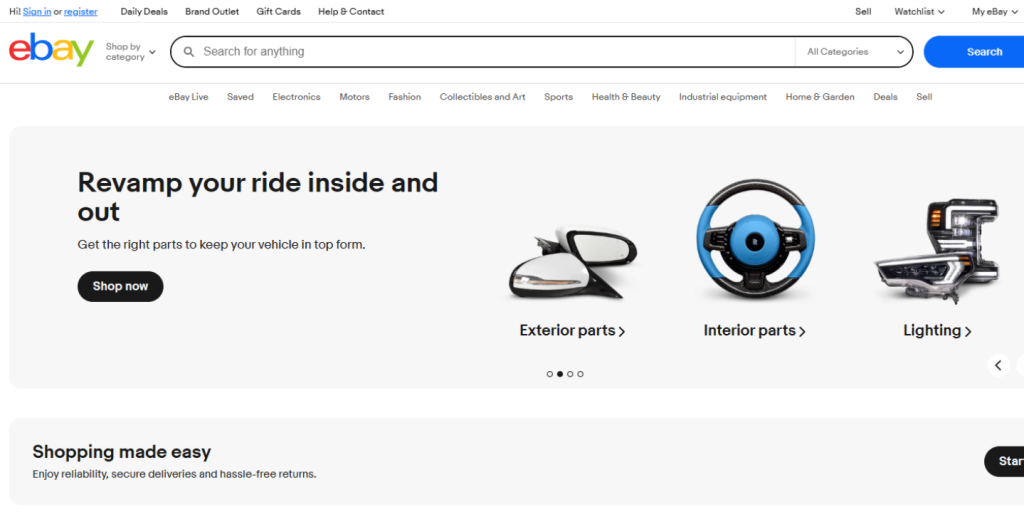
What is eBay (the marketplace)?
Concept in simple terms
This option is a global marketplace. You don’t create a website; you open a seller account and post listings on a platform that already has millions of buyers.
How selling works
You:
- Register as a seller.
- Create listings with photos, titles, descriptions, and item specifics.
- Pick a format (auction or fixed price).
- Ship orders and handle messages through the built-in dashboard.
Selling on an existing marketplace
Your items appear:
- In search results when buyers type in relevant keywords.
- In category pages, filters, and occasionally recommended sections.
You can pay extra to boost visibility with promoted placements.
Auction vs fixed price
- Auction: buyers bid for a limited time; good for rare or uncertain-value items.
- Fixed price: buyers click and purchase immediately; most serious sellers rely on this format for stable income.
Who this suits best
- Casual sellers clearing out personal items.
- Shops dealing in vintage pieces, hobby goods, and hard-to-find parts.
- Liquidators and wholesalers offloading mixed lots and surplus stock.
Strengths
- Instant audience: you don’t need to build traffic from scratch.
- Low barrier: no domain, hosting, or design decisions.
- Structured protections: disputes and payments flow through the platform’s systems.
Limitations
- Fees: a percentage of each sale plus a per-order charge quickly eats into margin, especially in competitive categories.
- Branding limits: your storefront is a profile page; the overall look belongs to the marketplace.
- Dependence: policy changes or ranking adjustments can impact your income overnight.
What is Shopify (the hosted store)?

Concept in simple terms
This route gives you your own ecommerce site under a domain you control. The provider handles hosting, security, and checkout infrastructure while you focus on products, design, and marketing.
How it works
You:
- Sign up and choose an appropriate plan.
- Pick a theme and customise layout, colours, and sections.
- Add products, collections, and informational pages.
- Configure payments, shipping, and taxes.
- Extend functionality with apps (email, reviews, upsells, subscriptions, etc.).
1. Building your own branded shop
You get:
- A custom domain (e.g. yourbrand.com).
- A home page, collection pages, product pages, and blog.
- A design tailored to your niche and positioning.
2. Themes and apps
- Themes determine the general look; you adjust them with a visual editor.
- Apps add features like loyalty programs, advanced analytics, automated emails, and more.
Who does this suit best
- Direct-to-consumer brands that want a recognisable identity.
- Businesses planning to sell for years, not months.
- Sellers who want control over customer data and marketing channels.
Strengths
- Scalable structure: suitable for tiny shops and high-volume brands.
- Multi-channel selling: online store, social platforms, marketplaces, and in-person sales can share one inventory.
- Rich ecosystem: agencies, developers, and thousands of apps to extend your setup.
Limitations
- Traffic is your problem: SEO, ads, social, or marketplaces must be plugged in.
- Recurring costs: subscription plus whatever apps you decide to keep.
- More to learn: especially around marketing and conversion optimisation.
Side-by-side comparison
This is where we directly answer eBay vs shopify, is shopify better than eBay, and which setup suits which seller.
Features
- Marketplace: core tools revolve around listings, search visibility, seller ratings, and basic analytics.
- Store builder: full website, cart, checkout, customer accounts, blog, and better control over on-page content.
For basic resale, marketplace tools are enough. For brand-building and content marketing, the hosted store wins.
Pricing and fees
- Hosted store: fixed monthly fee + card processing. Better when you have consistent sales and healthy margins.
- Marketplace: no mandatory monthly fee for basic use, but every order is charged a percentage plus an order fee. Better when you’re starting from scratch or selling occasionally.
A simple rule:
- If you’re not sure you can sell consistently yet, test on the marketplace.
- Once volume is stable, run the numbers—you’ll usually find the standalone shop keeps more profit per order.
Ease of use
- Marketplace: quickest to launch; your first listing can be live the same day.
- Hosted store: takes longer but gives you a proper branded home instead of just listings.
SEO and visibility
- Marketplace: strong internal search and decent visibility in Google for generic buy X queries.
- Store builder: full control over titles, URLs, and content, plus a blog, making it much better for long-term SEO.
Shipping and fulfilment
- Both options let you connect carriers and print labels.
- The marketplace keeps shipping inside its interface; the hosted shop lets you integrate with third-party fulfilment networks, dropshipping suppliers, and print-on-demand services.
Payments
- Marketplace: uses its own managed payment system; fees are baked into the final value charge.
- Store platform: uses a payment gateway (often the in-house one) and charges standard card processing rates; you can also plug in external gateways if needed.
Offline selling
- Marketplace: mainly online only.
- Hosted store: offers a POS system so you can sell at markets or in a physical shop with shared inventory and reporting.
Branding and customization
- Marketplace: small branding touches (logo, banner, a bit of layout), but you’re always living inside their design.
- Hosted store: complete control of layout, colour, imagery, fonts, and structure; buyers remember your domain, not someone else’s.
Integrations and ecosystem
- Marketplace: integrates with multi-channel tools, inventory systems, and shipping software.
- Hosted store: integrates with far more marketing and automation tools and can also connect to the marketplace, social platforms, and other channels.
This is why many brands eventually stop treating it as Shopify vs eBay and simply plug the marketplace into their existing shop.
Real-world patterns
Marketplace-first examples
Common successful profiles:
- Fashion, sneaker, and electronics resellers.
- Vintage traders and hobby-niche sellers.
- Businesses are moving returned items or overstock.
They win by sourcing well, pricing correctly, and using marketplace search data to know what actually sells.
Store-first examples
Common profiles:
- DTC brands with strong visual identity (fitness wear, beauty, home goods, supplements).
- Niche brands use content and email to nurture repeat customers.
- Stores that later upgrade to higher tiers to support international expansion or wholesale.
Hybrid strategy
Many sellers end up with:
- The hosted shop is the main base (brand, email, blog, main catalog).
- The marketplace is another channel feeding extra orders.
- Inventory and orders synced through multi-channel tools.
Key lessons
- Marketplace is perfect for proof of concept and cash flow.
- The independent shop is best for building long-term value.
- Combining both is often the most resilient setup.
Is Shopify better than eBay? A simple decision lens
Advantages of the marketplace
- Launch extremely quickly.
- Tap into existing shoppers.
- No monthly subscription required for basic selling.
Advantages of the hosted shop
- Own your brand, data, and website.
- Easier to improve margins at scale.
- Better suited for a multi-channel strategy and in-person selling.
- Stronger for content-driven growth and SEO.
Main drawbacks
- Marketplace: heavy reliance on platform rules and fees; hard to stand out as a brand.
- Hosted shop: more work upfront and ongoing marketing responsibilities.
Verdict by seller type
- Side-hustle reseller: marketplace first, shop later (if it sticks).
- Brand selling your own products: shop first, marketplace as an add-on.
- High-volume reseller: both, using software to keep stock and orders in sync.
- Retail store with a physical location: shop with POS, marketplace for clearance.
So which one should you choose?
Quick checklist
You’re leaning towards an independent shop if you answer
yes to most of these:
- Do you want a recognisable brand name?
- Do you care about collecting emails and repeat buyers?
- Are you planning to sell the same range for years, not just months?
If not, the marketplace is probably a more sensible starting point.
When the marketplace is the best starting point
- You sell used or unique items and don’t know which categories will work.
- You want to test demand before committing to a full site.
- Cash flow matters more than branding right now.
When the hosted shop is the better choice
- You already have a product line or clear brand concept.
- You want to invest in SEO, content, and email.
- You’re building a business you expect to grow steadily over time.
Why using both often wins
- Your own shop acts as the control centre.
- The marketplace becomes a traffic and sales source, not the entire business.
- If one channel changes rules or costs, you’re not trapped.
Practical next steps
If you start with the marketplace
- Focus on one niche.
- Use sold-items data and fee calculators before buying inventory.
- Optimise your titles and photography.
- Once you know what sells, consider building a separate shop for those winners.
If you start with a hosted shop
- Define your niche and messaging clearly.
- Launch with a simple, fast theme and a tight product range.
- Turn on at least one consistent traffic source (SEO plan, ads, or social + email).
- When sales are stable, connect the marketplace as an extra channel.
Conclusion
- This isn’t just Shopify vs eBay; it’s brand vs marketplace, long-term asset vs quick channel.
- Use the marketplace for speed and validation, the independent shop for serious growth.
- Most resilient businesses eventually rely on both, with the store as the foundation.
When you’re ready to treat that shop as a real growth engine—fast pages, conversion-focused design, and reliable integrations—it’s worth partnering with a specialist Shopify Development Company rather than trying to hack everything together alone.