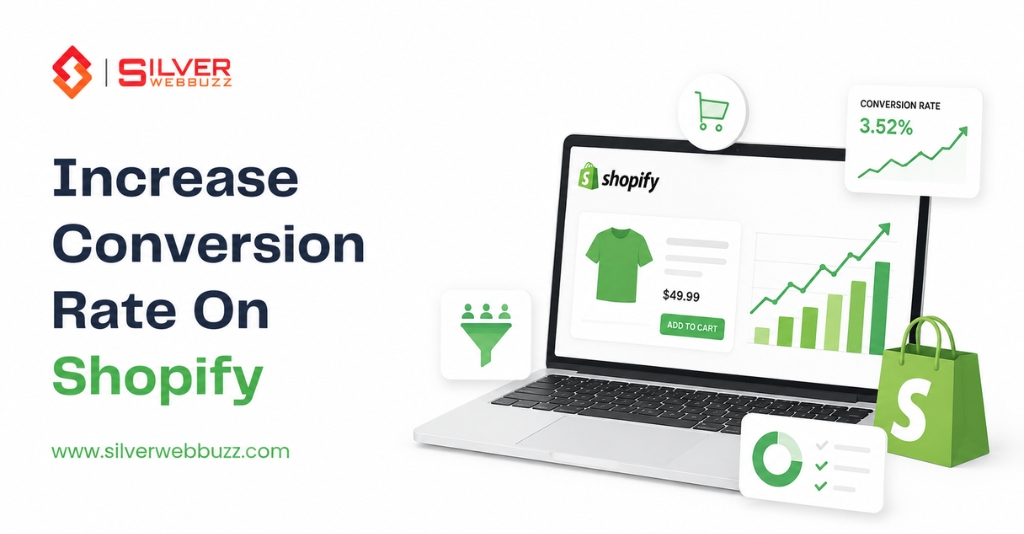
If you’re getting traffic to your Shopify store but visitors aren’t buying, you’re not alone. Many Shopify merchants focus heavily on attracting more visitors while overlooking the factor that often delivers the biggest revenue gains: conversion rate optimization (CRO).
The good news? You don’t always need more traffic to increase sales. By improving your Shopify conversion rate, you can generate significantly more revenue from the visitors you’re already getting.
In this guide, you’ll learn exactly how to increase conversion rate on Shopify using proven strategies trusted by successful ecommerce brands. Whether you’re running a new store or an established online business, these tactics can help turn more browsers into buyers.
Quick Answer: How to Increase Conversion Rate Shopify
Key Takeaways
- Optimize your product pages with compelling descriptions, high-quality images, videos, and social proof.
- Simplify the checkout process by reducing friction, offering multiple payment methods, and enabling guest checkout.
- Build trust through customer reviews, security badges, clear policies, and transparent shipping information.
- Improve site speed and mobile experience, as slow-loading stores significantly reduce conversions.
What Is a Good Shopify Conversion Rate?
Before optimizing, it’s important to understand your benchmark.
A Shopify conversion rate measures the percentage of visitors who complete a desired action, typically making a purchase.
Conversion Rate Formula
Conversion Rate = (Number of Orders ÷ Number of Visitors) × 100
For example:
- 5,000 visitors
- 150 orders
Conversion Rate = (150 ÷ 5,000) × 100 = 3%
Shopify Conversion Rate Benchmarks
While rates vary by industry, generally:
| Conversion Rate | Performance |
|---|---|
| Below 1% | Needs improvement |
| 1% – 2% | Average |
| 2% – 3.5% | Good |
| 3.5% – 5% | Very good |
| Above 5% | Excellent |
The goal isn’t simply to reach a specific number. It’s to continuously improve your store’s ability to convert visitors into customers.
Why Shopify Stores Fail to Convert
Many ecommerce stores lose potential customers because of:
- Slow page loading speeds
- Poor mobile experience
- Weak product descriptions
- Complicated checkout processes
- Lack of trust signals
- Unexpected shipping costs
- Limited payment options
- Insufficient customer reviews
The strategies below address these common conversion killers.
15 Proven Strategies That Drive More Sales
1. Optimize Product Pages for Purchase Intent
Your product page is where most buying decisions happen.
A visitor should immediately understand:
- What the product is
- Why it’s valuable
- Why they should trust your brand
- How to purchase it
Best Practices
- Write Benefit-Focused Product Descriptions
- Instead of listing features, explain outcomes.
Weak Example:
- Stainless steel bottle
- 750ml capacity
Better Example:
- Keeps drinks cold for 24 hours
- Large enough to stay hydrated throughout your workday
Use High-Quality Product Images
Include:
- Multiple angles
- Lifestyle photos
- Zoom functionality
- Close-up details
Add Product Videos
- Videos help customers visualize ownership and usage.
- Even short 15-30 second demonstrations can significantly improve conversions.
2. Improve Shopify Store Speed
Every second matters.
Research consistently shows that slower websites experience lower conversion rates.
Common Speed Improvements
- Compress images
- Remove unused apps
- Use modern image formats
- Minimize heavy scripts
- Choose a fast Shopify theme
Expert Insight
Many store owners add dozens of apps without realizing each app can add extra code and slow down performance. Regularly audit installed apps and remove those that no longer provide value.
3. Build Trust with Customer Reviews
Online shoppers rely heavily on social proof.
If visitors see that others have purchased and enjoyed your products, they feel more confident buying.
Add Reviews to:
- Product pages
- Collection pages
- Homepage sections
Encourage More Reviews
Send automated post-purchase emails asking customers to leave feedback.
Include:
- Star ratings
- Written reviews
- Customer photos
User-generated content often converts better than branded content.
4. Create a Mobile-First Shopping Experience
Mobile commerce continues to dominate ecommerce traffic.
Yet many Shopify stores still design primarily for desktop users.
Mobile Optimization Checklist
- Large buttons
- Easy navigation
- Fast loading pages
- Readable text
- Simplified forms
- Mobile-friendly checkout
Test every step of your customer journey on a smartphone.
If buying feels difficult, conversions will suffer.
5. Simplify the Checkout Process
Checkout friction is one of the biggest causes of cart abandonment.
Ways to Improve Checkout
Enable Guest Checkout
Don’t force account creation.
Many shoppers abandon purchases when required to register first.
Reduce Form Fields
Only ask for essential information.
Every extra field creates friction.
Offer Autofill Support
Allow customers to complete forms quickly on mobile devices.
6. Offer Multiple Payment Options
Customers expect flexibility.
The more payment methods you provide, the fewer customers you lose.
Popular Payment Methods
- Credit cards
- Debit cards
- PayPal
- Apple Pay
- Google Pay
- Shop Pay
- Buy Now Pay Later solutions
Shop Pay is particularly effective because it enables faster repeat purchases.
7. Display Clear Shipping Information
Unexpected shipping costs are a major reason shoppers abandon carts.
Best Practices
Display:
- Shipping costs upfront
- Delivery estimates
- Free shipping thresholds
- Return policy information
For example:
“Free shipping on orders over $50.”
This not only improves trust but can also increase average order value.
8. Use Strategic Urgency and Scarcity
When used ethically, urgency encourages action.
Examples
- Low inventory alerts
- Limited-time promotions
- Seasonal sales
- Countdown timers
Avoid fake scarcity tactics. Authenticity builds long-term trust and customer loyalty.
9. Strengthen Your Value Proposition
Visitors should immediately understand why they should buy from you instead of competitors.
Ask Yourself
What makes your store unique?
Examples include:
- Premium quality
- Faster shipping
- Better customer support
- Exclusive products
- Sustainability commitment
Your value proposition should be visible above the fold on key pages.
10. Optimize Your Call-to-Action Buttons
Your CTA buttons directly influence conversion behavior.
Effective CTA Examples
- Buy Now
- Add to Cart
- Get Yours Today
- Start Your Order
CTA Best Practices
- Use contrasting colors
- Make buttons large enough to notice
- Position them prominently
- Repeat them on long pages
The goal is to make purchasing effortless.
11. Recover Abandoned Carts
Many shoppers leave before completing checkout.
Recovering even a small percentage can dramatically increase revenue.
Abandoned Cart Recovery Strategies
Automated Email Sequences
Send reminders:
- After 1 hour
- After 24 hours
- After 72 hours
Include Incentives
Examples:
- Small discount
- Free shipping
- Bonus gift
Often, a simple reminder is enough to recover the sale.
12. Use Upselling and Cross-Selling
Increasing conversion value is just as important as increasing conversion rate.
Upsell Examples
- Premium version of a product
- Larger package size
- Subscription option
Cross-Sell Examples
- Accessories
- Complementary products
- Bundles
These recommendations work best when genuinely helpful.
13. Leverage Social Proof Beyond Reviews
Customers trust other customers.
Types of Social Proof
- Customer testimonials
- User-generated content
- Influencer mentions
- Case studies
- Customer success stories
Showcasing real customer experiences reduces purchase hesitation.
14. Improve Navigation and Site Structure
Visitors should find products quickly.
Navigation Best Practices
- Clear category organization
- Search functionality
- Product filters
- Breadcrumb navigation
Confusing navigation often leads to frustration and lost sales.
Remember: every additional click creates an opportunity for visitors to leave.
15. Continuously A/B Test Your Store
Conversion optimization is never finished. Even small improvements compound over time.
Elements Worth Testing
- Headlines
- Product images
- CTA buttons
- Pricing displays
- Product descriptions
- Checkout flow
- Promotional banners
Make one change at a time so you can accurately measure results.
Common Shopify Conversion Rate Mistakes to Avoid
Many merchants unknowingly hurt conversions by making these mistakes:
Mistake #1: Too Many Pop-Ups
Excessive pop-ups can overwhelm visitors.
Mistake #2: Weak Product Photography
Poor visuals reduce perceived product value.
Mistake #3: Hidden Shipping Costs
Unexpected fees create checkout abandonment.
Mistake #4: Ignoring Mobile Users
Mobile traffic often represents the majority of visitors.
Mistake #5: Lack of Trust Signals
No reviews, testimonials, or security indicators can make shoppers hesitant.
Shopify Conversion Rate Optimization Checklist
- Use this quick checklist:
- Improve page speed
- Optimize product descriptions
- Add high-quality images and videos
- Display customer reviews
- Enable guest checkout
- Offer multiple payment methods
- Show clear shipping information
- Create mobile-friendly experiences
- Recover abandoned carts
- Use upselling and cross-selling
- Strengthen trust signals
- Test and optimize continuously
Final Thoughts
Learning how to increase conversion rate Shopify is one of the most profitable investments an ecommerce business can make. Instead of spending more on advertising, conversion optimization helps you maximize the value of existing traffic.
Start by focusing on the fundamentals:
- Better product pages
- Faster site performance
- Strong trust signals
- Simplified checkout
- Mobile optimization
Then continuously test, measure, and refine.
Even a modest increase in conversion rate can have a significant impact on revenue, profitability, and long-term business growth. The most successful Shopify brands treat conversion optimization as an ongoing process—not a one-time project.