Since the arrival of generative AI in late 2022, the eCommerce landscape has undergone a dramatic transformation. What started as experimentation has now evolved into a core business strategy for leading brands.
At Silver Webbuzz, we work closely with eCommerce businesses implementing AI-driven solutions—from personalization engines to predictive analytics. This gives us a front-row view of how AI is not just a trend—but a revenue-driving force.
This guide compiles the most credible, research-backed AI in eCommerce statistics, combined with expert insights to help you understand where the industry is heading—and how you can stay ahead.
AI in E-commerce: Key Statistics & Highlights
- 80% of retailers are already using or piloting generative AI
- The global AI eCommerce market could reach $74 billion by 2034
- AI-referred traffic has surged by 4,700% year-over-year
- AI chat delivers 4x higher conversion rates
- 84% of eCommerce brands rank AI as their top strategic priority
Market Size & Growth Projections
AI in eCommerce Market Is Set for Explosive Growth
The global AI in eCommerce market was valued at $7.25 billion in 2024 and is projected to reach $64–75 billion by 2034, growing at a CAGR of 23.6%.
This growth reflects increasing investments in:
- AI-powered recommendation engines
- Conversational commerce
- Predictive analytics platforms
Regional Growth Trends
North America dominates with ~39% market share
Asia-Pacific is the fastest-growing region, driven by:
- Mobile-first consumers
- Rapid digital commerce expansion
- Faster AI adoption
Agentic Commerce: The Next Trillion-Dollar Opportunity
By 2030:
- AI-driven commerce could influence $3–$5 trillion in global revenue
- Up to $1 trillion in U.S. retail could be AI-mediated
This marks the shift toward “agentic commerce”—where AI doesn’t just assist but actively makes buying decisions.
AI Adoption in eCommerce
AI adoption in eCommerce has moved far beyond the experimental phase. Today, it is becoming a core part of business strategy.
More than 80% of retail and consumer goods companies are already using or testing AI, and nearly 90% plan to increase their investment in the near future.
However, there is a clear divide between adoption and scale. While nearly half of large enterprises have successfully scaled AI across their operations, less than 30% of small businesses have achieved the same level of integration.
This gap is not due to lack of awareness, but rather challenges in execution—particularly around data infrastructure and technical expertise.
Additionally, 84% of eCommerce businesses now consider AI their top strategic priority, and 71% are planning to hire dedicated AI talent within the next year.
From our perspective, this signals a major shift: AI is no longer confined to IT departments—it is now central to growth, marketing, and customer experience strategies.
You may also like: How AI in eCommerce is Transforming Online Shopping in 2026
Revenue Impact & Conversion Rates
AI Personalization Drives Measurable Growth
5–15% average revenue lift from personalization
Top-performing brands see up to 25% increase
AI Improves Conversion Rates Dramatically
- AI chat converts at ~12.3% vs 3.1% without AI
- That’s roughly 4x higher conversions
Why it works:
- Real-time assistance
- Reduced decision friction
- Personalized product suggestions
AI Boosts Sales & Retention
- 67% of marketing & sales teams report revenue increases
- 79% of brands say conversational AI improves sales
- 23% report higher customer retention
AI Reduces Operational Costs
- 91% of companies say AI reduces supply chain costs
- 51% use AI for operational efficiency
AI-Referred Traffic & Product Discovery
Search Behavior Is Changing
- 44% of users now prefer AI-powered search
- Brands cited in AI results see 35% higher CTR
AI Traffic Is Exploding
- AI-referred traffic grew 4,700% YoY
- Visitors from AI sources spend 32% more time on site
Where AI Gets Its Information
Top AI citation sources include:
| Rank | Source | Approx. Share |
|---|---|---|
| 1 | ~29% | |
| 2 | Alibaba | ~16% |
| 3 | Forbes | ~14% |
| 4 | Wikipedia | ~11% |
| 5 | YouTube | ~7% |
Top AI Use Cases in eCommerce
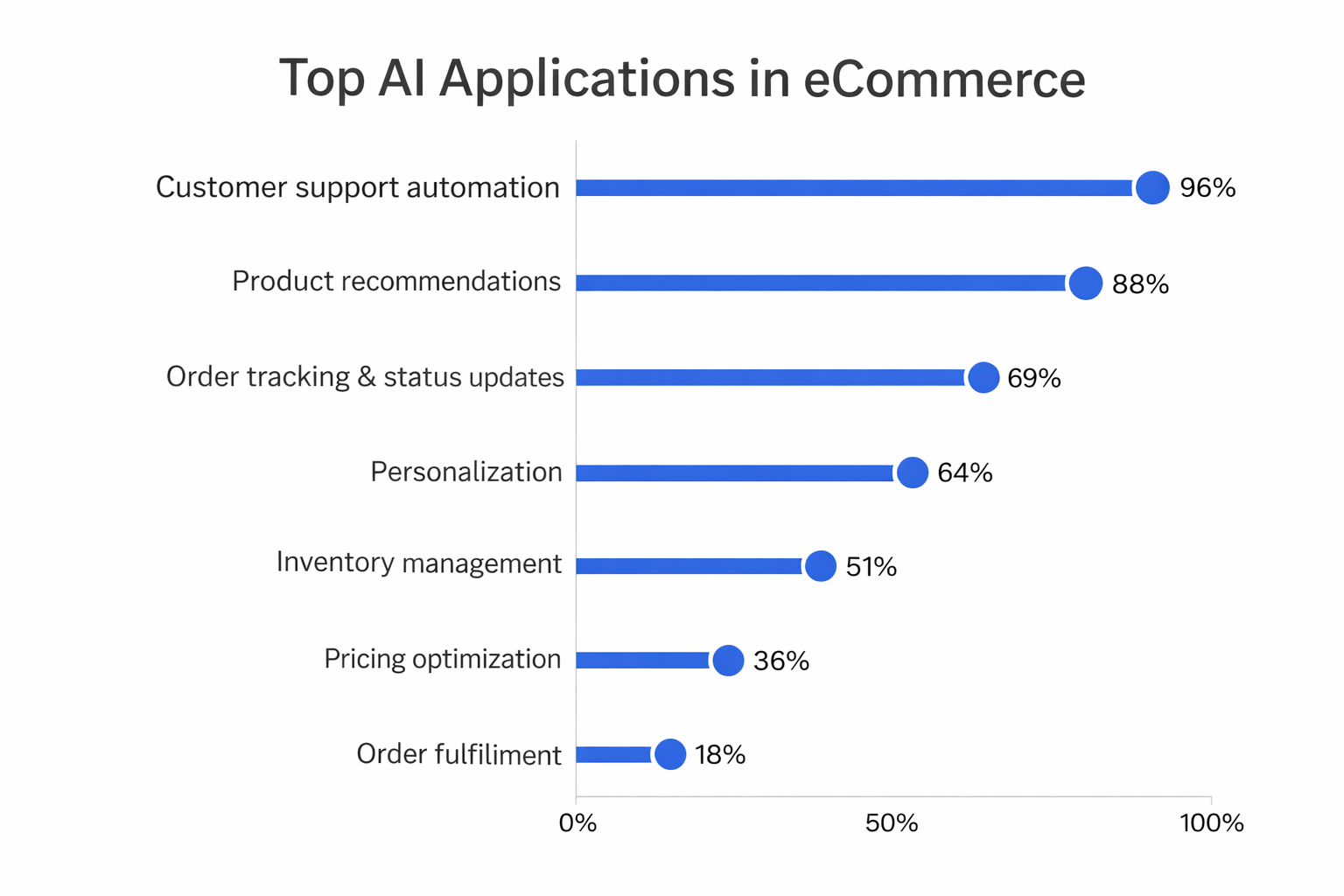
AI is now integrated across multiple business functions, delivering value at every stage of the customer journey.
Most Common Use Cases:
Customer Support
96% of brands use AI for customer support
- AI chatbots and virtual assistants
- 24/7 automated query resolution
- Faster response times
Marketing & Content
67% of retailers use AI for:
- Product descriptions and ad creatives
- Campaign optimization
- Email personalization
Supply Chain
64% use AI for demand forecasting
- Inventory optimization
- Logistics planning
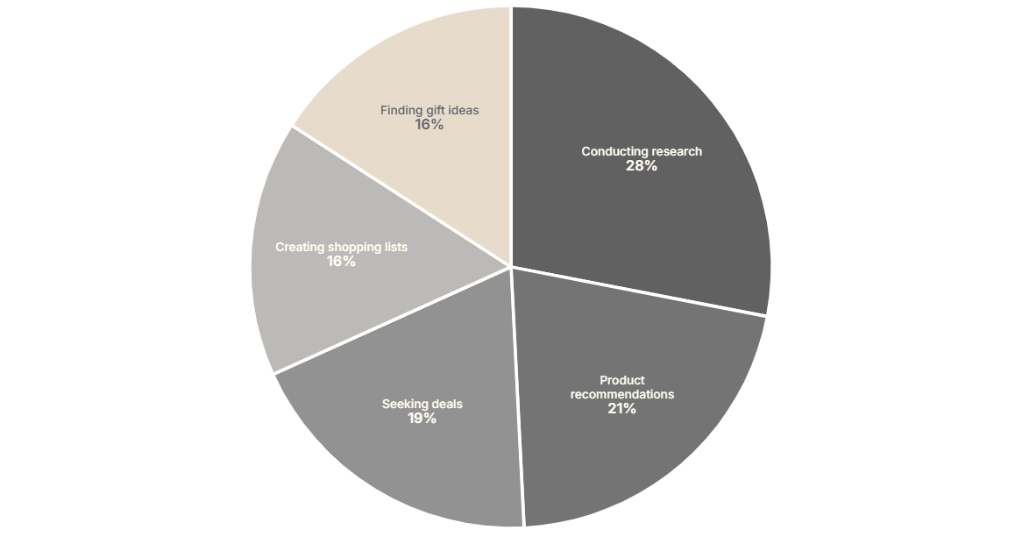
Source: triplewhale
Customer Analytics
38% of U.S. consumers use AI for shopping tasks like:
- Behavior tracking
- Purchase prediction
- Segmentation
- Product research
- Comparison
- Recommendations
Consumer Behavior & Trust
While AI adoption is growing, consumer behavior reveals an important balance between automation and trust.
Younger audiences, especially Gen Z, are leading AI adoption in shopping. However, customers still value human interaction in critical situations.
Consumer Insights:
- 58% of Gen Z use AI for product discovery
- 67% of users have a positive view of AI
- 54% prefer human support for order issues
- Reviews remain a key trust factor
Consumers also prefer a hybrid experience:
- AI summaries + real reviews
- Automation + human support
Barriers to AI Implementation
1. Data Infrastructure Challenges
Many businesses:
- Spend 40% of time on data cleanup
- Struggle with siloed systems
One of the biggest obstacles is data infrastructure. Many businesses still struggle with fragmented systems and poor data quality, which limits the effectiveness of AI tools.
2. Talent Shortage
- AI talent shortage jumped from 31% to 46%
Talent shortage is another major issue. The demand for skilled AI professionals has increased significantly, making it difficult for companies to build and scale AI capabilities.
3. AI Limitations
- 41.5% worry AI can’t fully resolve customer queries
- Top concern: Unreliability (26%)
There are also concerns about reliability. A significant number of businesses worry that AI cannot fully handle complex customer interactions, while issues such as inaccurate outputs and hallucinations continue to be areas of concern.
Final Thoughts
AI is no longer an emerging trend in eCommerce—it’s a core driver of growth, efficiency, and customer experience. From personalization and automation to predictive analytics, businesses leveraging AI are seeing measurable improvements in conversions, revenue, and operational performance. However, success doesn’t come from simply adopting AI tools. It requires a clear strategy, strong data foundations, and continuous optimization.
At Silver Webbuzz, we believe the real advantage lies in combining AI capabilities with human expertise. Brands that strike this balance can deliver smarter, faster, and more meaningful shopping experiences.
As the industry evolves toward more autonomous and personalized commerce, one thing is certain: businesses that invest in AI today will be the ones leading tomorrow’s eCommerce landscape.